Domitilla Catacombs Guide - Frescoes, History, Visit Planning
Discover Domitilla through art-rich interpretation, practical planning, and a story-first underground route.
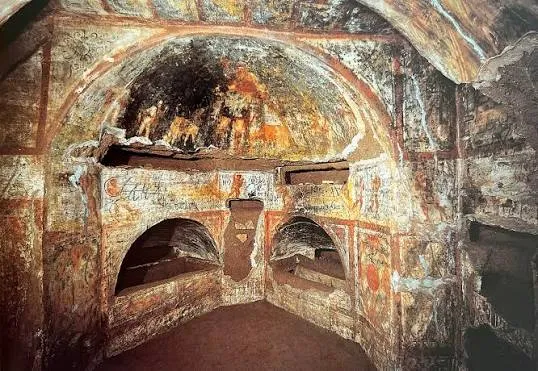
Domitilla is where visual theology survives in low light. The site rewards travelers who move slowly enough to let image, corridor, and silence interact.
Why Domitilla is uniquely rewarding
- Strong fresco presence compared with many first-time expectations.
- Long corridor sequences that create immersive pacing.
- A remarkable balance between archaeology and symbolic narrative.
How to read frescoes without overcomplicating
Step 1: Identify the figure or scene.
Step 2: Observe color, line, and emphasis.
Step 3: Locate it within chamber function.
Step 4: Ask what hope-language it communicates.
Extended visit flow (90+ minutes)
Opening pass
Start with broad orientation: route shape, chamber density, conservation constraints.
Mid-visit concentration
Choose three fresco zones and compare:
| Zone | What to observe | Question to ask |
|---|---|---|
| Ceiling fields | Decorative rhythm | Is motif purely ornamental? |
| Narrative scene area | Figure hierarchy | What is being taught visually? |
| Transition corridor | Surface change | Why less decoration here? |
Closing synthesis
Write one sentence per zone. Short synthesis beats perfect synthesis.
Micro-essay prompt
"In Domitilla, color acts as memory reinforcement under spatial pressure." Do you agree after your visit?
Practical tips
- If your group pace is quick, request one focused stop for iconography.
- Keep one hand free (no juggling bags/phones) for safer corridor movement.
- Pair Domitilla with a lighter outdoor stretch to avoid cognitive overload.
Final line
Domitilla proves that sacred art does not need grand halls; it can transform narrow walls into durable hope.
著者について

Rome Sacred History Desk
本ガイドは、訪問者がローマ地下墓地に自信と敬意、そして好奇心をもって向き合えるよう、実践的計画支援と厚みある歴史背景を統合して作成されています。穏やかで明瞭、記憶に残る体験を目指しています。
Tags
Comments (0)
Loading comments...